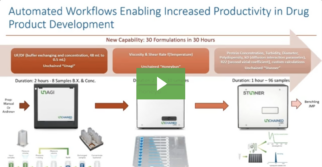


Biotherapeutic pipelines don’t just juggle monoclonal antibodies anymore, they need to be ready for protein conjugates like ADCs and for teeny tiny peptides. Even beyond new modalities, automation is pushing throughput higher so that analytical tools for concentration and sizing need to read lots of samples as fast as possible, on the tiniest sample volumes, and with increasingly higher throughput. For ADCs, UV/Vis gets messy when payload absorbance overlaps the antibody signal, and aggregation risk increases as hydrophobic drug-linkers enter the mix. For peptides, answering the questions “How much do I have?” and “Has aggregation struck?” need to happen without turning characterization into a bottleneck.
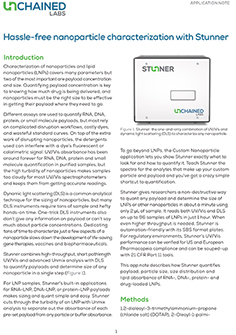
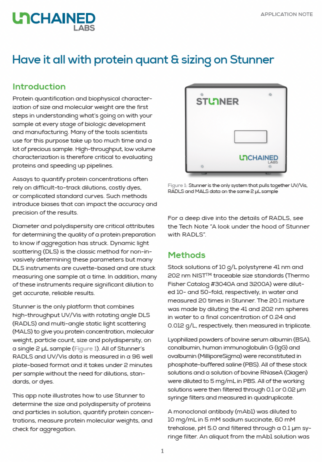
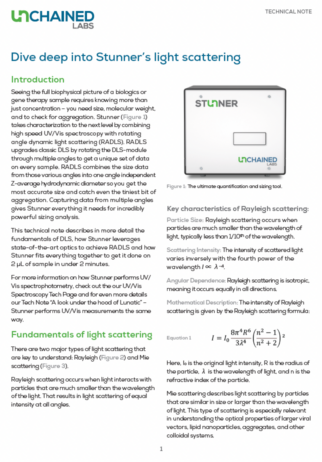
Stunner bundles quantification and sizing checks into a single read that can pinpoint sample concentration and raise the red flag when aggregation has struck. Full-spectrum UV/Vis quantifies while dynamic light scattering (DLS) checks size and aggregation on the same 2 µL sample in a 96-well plate-based format. Stunner’s Unmix algorithms power applications to deconvolute UV/Vis spectra into protein, drug-linkers, nucleic acids, or other components, making quantification and drug-antibody ratio (DAR) reads simpler than ever. Since UV/Vis is read in the same run as DLS, Stunner streamlines workflows for proteins, ADCs, and peptides with less handoffs and variability.
In this webinar, brought to you by Unchained Labs, Kevin Lance will discuss how Stunner accelerates everything from routine sample checks and screening to final quality control across protein modalities. Kevin will present the technology behind rapid concentration and aggregation monitoring for proteins and peptides and the newest applications for fast DAR and concentration readouts for ADCs and other conjugates. Overall, this practical guidance will enable the identification of problematic samples and the knowledge to develop faster, sample-sparing, and downstream-friendly methods on Stunner.