

Systemic delivery of mRNA cargo by lipid nanoparticles (LNPs) remains limited by multiple barriers, with endosomal escape (EE) representing a major bottleneck. The molecular mechanisms underlying endosomal escape are not yet fully understood, and the specific LNP features that promote efficient EE and subsequent transfection remain unclear.
Utrecht University aim to develop an AI-based model capable of predicting EE and transfection efficiency. They are applying an explainable AI (XAI) to identify key LNP features that drive these outcomes, providing mechanistic insight into EE. To do so, they generated a library of approximately 300 LNPs that have been characterized and tested on cells. These LNPs are fluorescently labelled and contain eGFP-encoding mRNA, allowing for the analysis both cellular uptake and transfection efficiency. Fluorescent images are used as input for the AI model to extract and analyze relevant cellular features.
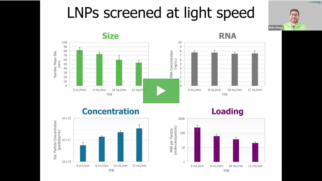
In this webinar, you’ll see how the team at the University of Utrecht are teaming up Sunscreen and Stunner with an AI model - to distinguish features associated with EE and high transfection efficiency. The AI model can identify clusters based on similarities in texture features, which have been annotated with EE and cell transfection data. Additionally, you’ll learn about the design and set-up for the 300 LNP screen, including LNP design and the workflow for LNP synthesis and characterization.