



AI-Driven Closed-Loop Experimentation
Design, execute, measure, and learn automatically
What is closed-loop experimentation?
Closed-loop experimentation is an iterative approach to lab automation in which the results of one experiment automatically shape the next. Unlike a fixed campaign, the experimental plan can adapt between cycles as new data become available. The loop continues until a defined objective, stopping criterion, or user decision ends the run.
A closed-loop system connects experimental design, automated execution, measurement, data analysis, and decision logic in one continuous feedback cycle. The decision logic may use Bayesian optimization, design of experiments, rules, or a custom model, depending on the scientific question.
- Adaptive by design: Experimental conditions evolve as the system learns from new results
- Efficient search: Decision logic focuses experiments on the most informative or promising regions
- Autonomous & traceable: Cycles can continue without manual intervention while inputs, actions, and outcomes remain recorded
How closed-loop experimentation works
Implementations vary, but every closed-loop experiment follows the same four-stage feedback cycle. The cycle repeats without a scientist reviewing results or launching each round.
1. Design: Translate the conditions selected by an optimizer into an executable experiment
2. Execute: Run those conditions using automated hardware
3. Measure: Capture the experimental outcome with an analytical method
4. Learn: Analyze and score the results, then use decision logic to select what runs next
What makes the loop work
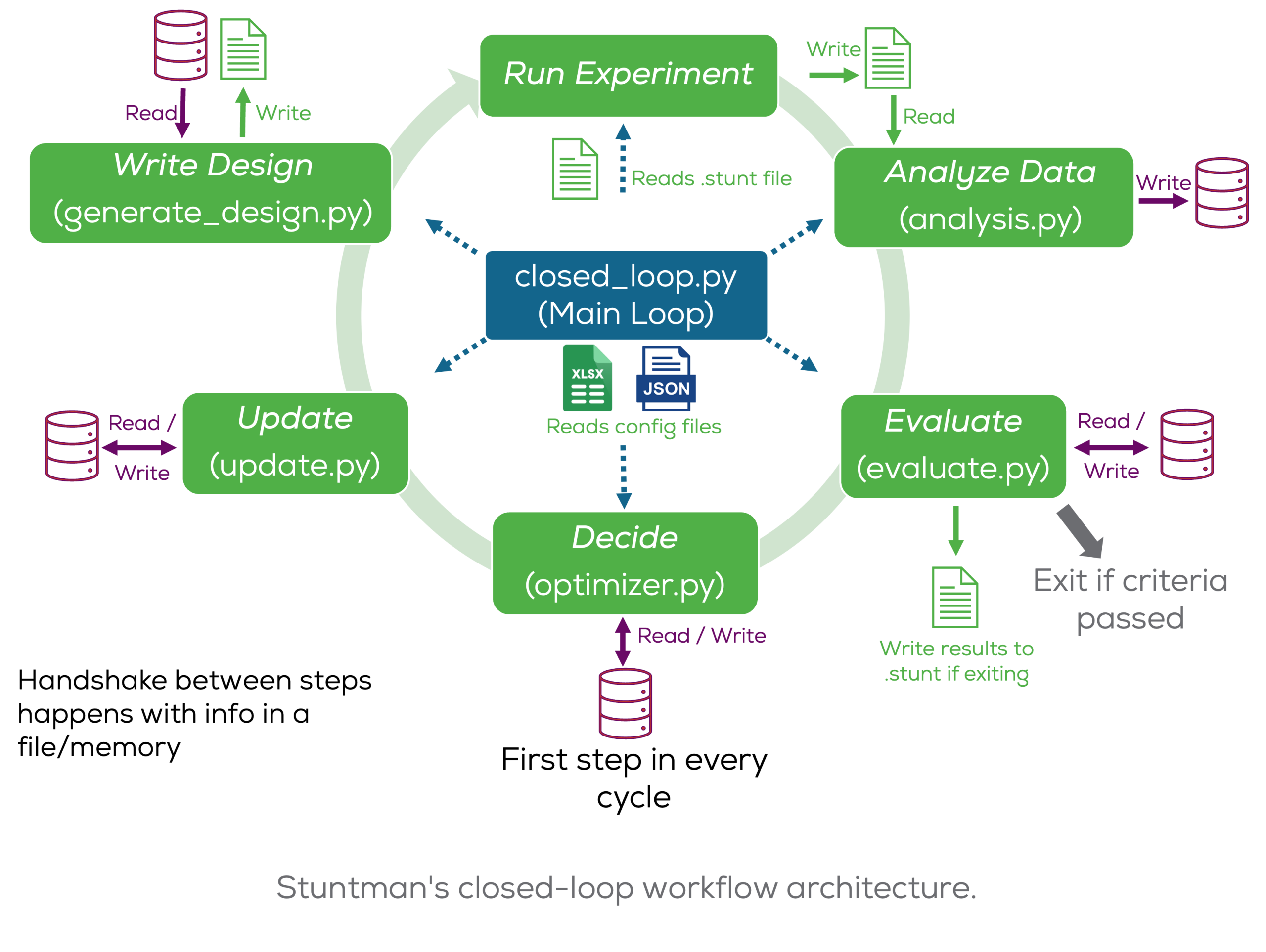
Closed-loop experimentation depends on reliable handoffs between software, automation hardware, and analytical instruments. A coordinating layer must pass conditions into the experimental workflow, trigger execution, retrieve results, and return those results to the decision engine.
Each cycle should retain the inputs, actions, measurements, scores, and next-condition decisions in a structured data record.
How decisions are made
The decision engine turns measured outcomes into the next set of experimental conditions. It may balance exploration where the experimental conditions test less certain regions with exploitation where the cycle is refining conditions that already show promise. The optimizer and objective function should reflect the scientific goal, constraints, and available data.
AI and optimization can play different roles. A language model can help translate natural-language objectives into scripts or explain and modify workflow logic. During execution, a validated optimizer or rules engine uses measured data to select the next conditions; no language-model response is required between cycles.
How convergence is determined
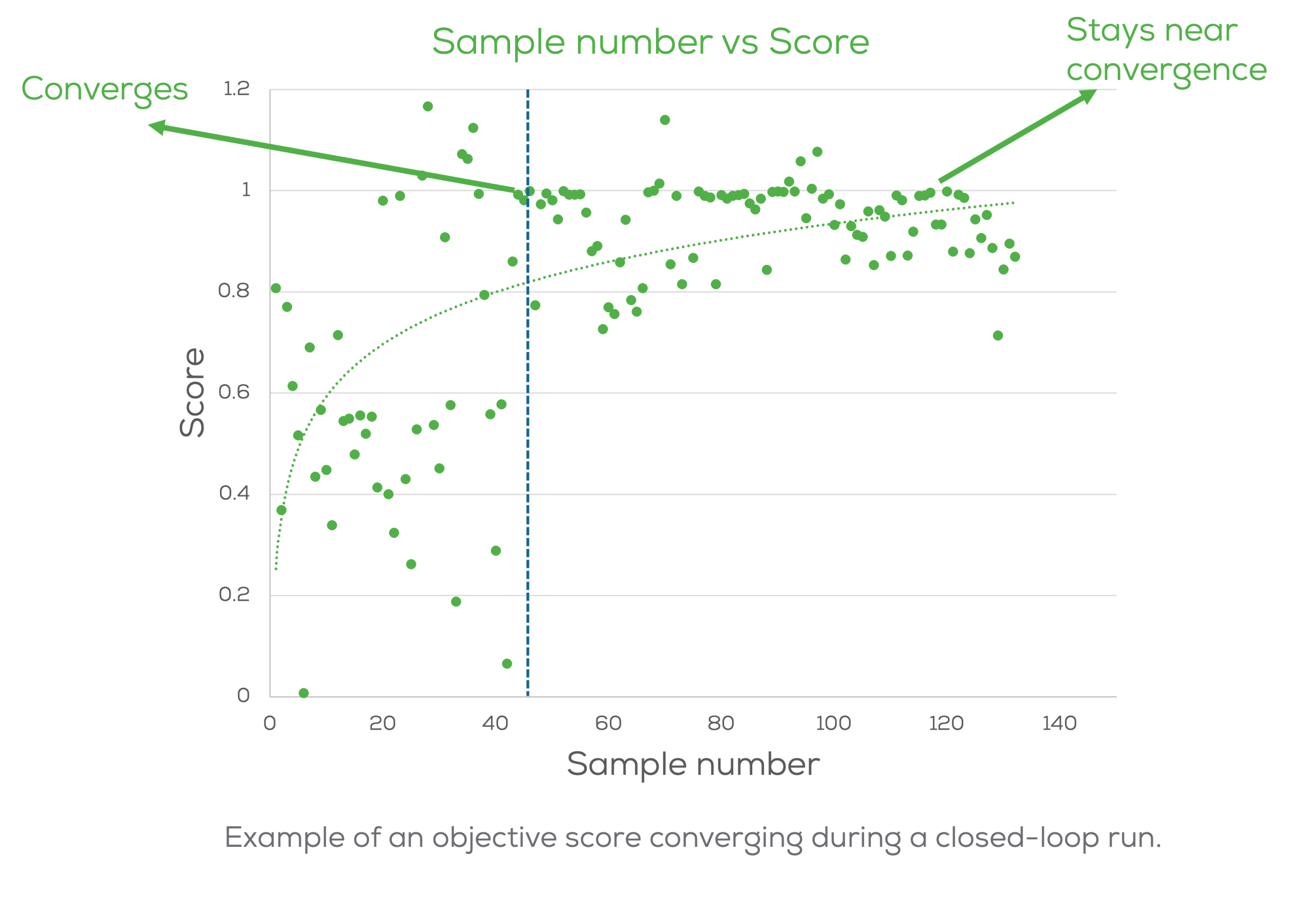
Convergence describes the point at which additional cycles are unlikely to produce a meaningful improvement. It can be defined by a plateau in the objective score, repeated selection of similar conditions, reduced uncertainty, achievement of a target, or a maximum cycle limit.
Reading a closed-loop result
Early cycles often explore broadly and produce a wide range of outcomes. As the system learns, later cycles should concentrate around stronger-performing regions while still testing enough new conditions to avoid settling too early. A well-designed run records both the experimental outcome and why each next condition was selected.
Where closed-loop experimentation fits
Closed-loop methods can support reaction screening and optimization, formulation and preformulation, electrolyte and polymer development, catalyst screening, and multi-parameter developability studies. The common requirement is a measurable objective and an experimental workflow that can be executed, analyzed, and repeated.
For the full architecture, the Bayesian optimizer, and how a cycle runs step by step, see the tech note Dive deep into Stuntman's closed-loop automation.
Stuntman
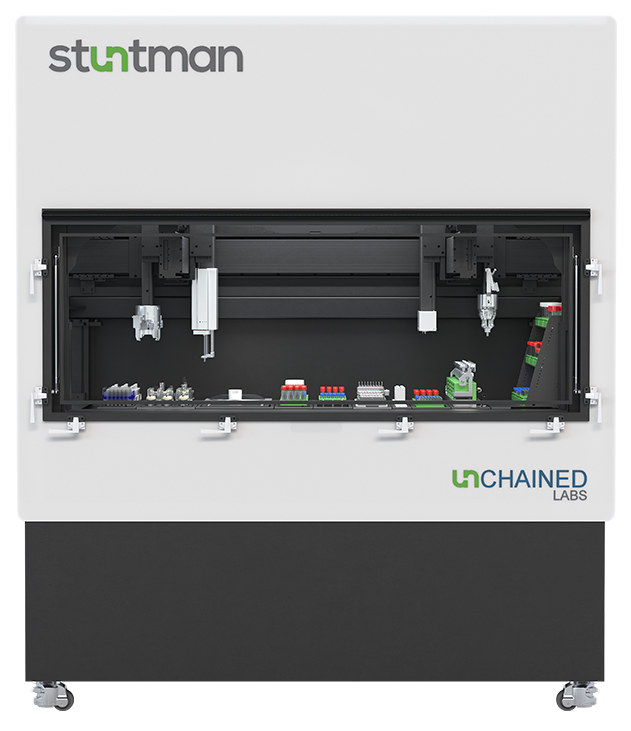
Closed-loop experimentation needs a physical system that can act on each new decision. Stuntman pairs built-in AI with fully modular hardware to prepare and run experiments, connect integrated analytical instruments, capture results, and return those results to the selected optimizer. Built-in AI can help scientists create and modify Python workflow scripts from natural-language descriptions, while reviewed and validated scripts coordinate execution. Flexible deck configurations allow the same technology to close the loop across small molecules & chemistry, materials & energy, and biologics & gene therapy. Adapt the same design–execute–measure–learn framework by changing the experimental configuration, execution methods, analytical measurements, and evaluation logic for reaction optimization and preformulation, electrolyte, polymer, catalyst, and multi-parameter developability screens. Or, check out our AI-driven Developability Workcell to see how Stuntman puts AI-driven automation to work in biologics, connecting sample preparation, analytics, and data-driven decisions in one integrated workflow.
FAQs
Ready for more?
See how closed-loop experimentation on Stuntman can fit your workflow - whatever your science